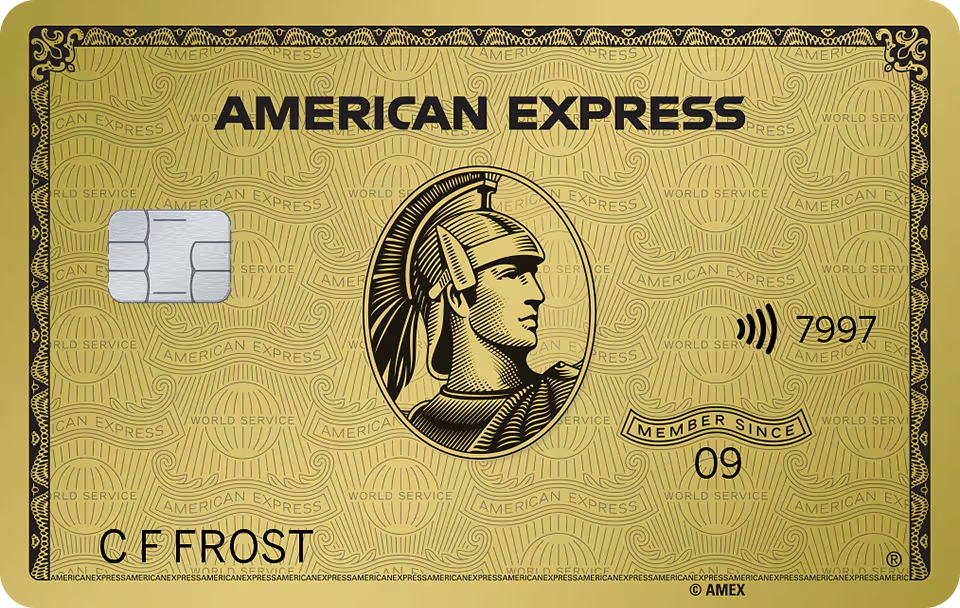
The American Express Gold Card earns 4x points at restaurants and comes with $220 in annual dining credits. At $500 per month in restaurant spending, it returns $580 in value against a $325 annual fee. No other card comes close on pure dining math.
But 4x points and a $325 fee is not the right answer for everyone. If you spend $150 a month at restaurants, a no-annual-fee card earning 3x or 3% puts more money in your pocket. The right card depends on how much you actually spend, not on which multiplier looks biggest on a marketing page.
The 5 Best Restaurant Cards Compared
| Card | Dining Rate | Annual Fee | Dining Credits | No FTF | Best For |
|---|---|---|---|---|---|
| Amex Gold | 4x MR points | $325 | $220/yr | Yes | Heavy diners ($400+/mo) |
| Chase Sapphire Preferred | 3x UR points | $95 | None | Yes | Travel + dining combo |
| Wells Fargo Autograph | 3x points | $0 | None | Yes | No-fee dining rewards |
| Capital One SavorOne | 3% cash back | $0 | None | Yes | Simple cash back |
| Citi Custom Cash | 5x TYP (up to $500/mo) | $0 | None | No | Low-spend diners |
American Express Gold Card
The Amex Gold earns 4x Membership Rewards at restaurants worldwide, including takeout and delivery, up to $50,000 per year in purchases. After the cap, the rate drops to 1x.
The card also has $220 in annual dining-specific credits: $120 from a $10/month credit at Grubhub, The Cheesecake Factory, Five Guys, Goldbelly, and Wine.com, plus $100 from a semi-annual Resy credit ($50 per half-year at Resy-connected restaurants). There is also $120 in annual Uber Cash ($10/month) that works for Uber Eats, bringing total credits to $340.
The math at $500/month in restaurant spending: 24,000 Membership Rewards points per year, worth $360 at 1.5 cents each through transfer partners like Delta, ANA, or Hilton. Add the $220 dining credits and you get $580 in value against the $325 fee. Net positive by $255 from dining alone.
The Amex Gold is the strongest restaurant card if you spend $400 or more per month on dining. Below that threshold, the annual fee becomes harder to justify with dining rewards alone. You can see the full breakdown of Amex Gold credits and benefits to estimate your personal return.
Chase Sapphire Preferred
The Chase Sapphire Preferred earns 3x Ultimate Rewards points on dining, including delivery and takeout. The $95 annual fee is less than a third of the Amex Gold's, and Chase explicitly codes DoorDash, Uber Eats, and Grubhub as dining-eligible.
At $500/month in restaurant spending, you earn 18,000 Ultimate Rewards points per year. Those are worth $270 at 1.5 cents each through Chase transfer partners (United, Hyatt, Southwest, British Airways). After the $95 fee, that is $175 net from dining alone.
The CSP does not have dedicated dining credits, so the value equation is simpler: points earned minus annual fee. It also earns 3x on select streaming and 2x on all travel, which means it pulls more weight across your full spending profile than a dining-only comparison suggests. If you eat out and travel, compare it directly against the Amex Gold to see which one wins for your spending mix.
Wells Fargo Autograph
The Wells Fargo Autograph earns 3x points at restaurants with no annual fee, no spending caps on bonus categories, and no foreign transaction fees. It also earns 3x on travel, gas, transit, streaming, and phone plans.
At $500/month in restaurant spending, you earn 18,000 points worth $180 as 1 cent per point statement credits. The gap between the Autograph and the Sapphire Preferred is the points currency. Chase Ultimate Rewards transfer to airline partners at 1.5+ cents per point. Wells Fargo Rewards are worth 1 cent each as statement credits, with a smaller set of transfer partners.
If you want restaurant rewards and do not want to pay an annual fee, the Autograph is the strongest option. Six bonus categories at 3x with no caps and no fee is hard to beat.
Capital One SavorOne
The Capital One SavorOne earns 3% cash back at restaurants, 3% on entertainment and streaming, and 3% at grocery stores. No annual fee, no foreign transaction fees, no spending caps.
Cash back is straightforward: $500/month at restaurants earns $180 per year in cash back. No transfer partners to optimize, no redemption strategy needed. The money shows up as a statement credit.
The SavorOne is the right choice if you want simplicity. You will not extract 1.5 cents per point through transfer partner gymnastics, but you will never leave value on the table by forgetting to redeem points before they devalue, either. The 3% rate at groceries and entertainment sweetens the overall picture if those categories are meaningful in your budget.
Citi Custom Cash
The Citi Custom Cash earns 5x ThankYou Points on your highest eligible spending category each billing cycle, automatically. If restaurants are your biggest category, it earns 5x on dining with no action required. No annual fee.
The cap is $500 per billing cycle. Spend exactly $500 at restaurants in a month and you earn 2,500 points worth $37.50 at 1.5 cents each (or $25 as cash back at 1 cent each). Go over $500 and everything above earns 1x.
This card is built for controlled spenders. If your restaurant budget is predictable and under $500/month, the 5x rate is the highest multiplier available with no annual fee. Above that, the cap limits the total value and a flat 3x or 4x card wins on annual returns. One caveat: the Citi Custom Cash charges a foreign transaction fee, so it is not the right card for dining abroad.
Weekend Pick: Citi Strata Elite
The cards above cover the main decision, but there is one card worth knowing about if you eat out on Friday and Saturday nights. The Citi Strata Elite earns 6x ThankYou Points at restaurants during "Citi Nights," defined as Friday and Saturday between 6PM and 6AM ET. Outside that window, it earns 3x at restaurants.
The $595 annual fee puts it in a different category. This is not a card you get for dining alone. But if you already carry it for the lounge access, travel credits, and transfer partners, the 6x weekend dining rate is the highest standard earn rate at restaurants on any general-purpose card. A $150 Friday dinner earns 900 ThankYou Points worth $13.50+ through transfer partners. I carry mine every weekend for exactly this reason.
During the week, the Amex Gold's 4x rate is still higher than the Strata Elite's 3x. The play is pairing both: Amex Gold Monday through Friday, Strata Elite on weekends.
How to Choose
The decision comes down to your monthly restaurant spending.
Under $200 per month, the Citi Custom Cash's 5x rate (capped at $500/cycle) earns the most points per dollar with no annual fee. The cap does not matter at this spend level.
Between $200 and $400 per month, the Wells Fargo Autograph or Capital One SavorOne earns consistent 3x/3% with no fee and no cap. The Autograph is better if you want points flexibility. The SavorOne is better if you want cash deposited and nothing to think about.
Above $400 per month, the Amex Gold's 4x rate and $220 in dining credits produce the highest net return. The $325 fee pays for itself at roughly $350/month in restaurant spending once you factor in the credits. At $600/month, the gap widens further: the Amex Gold returns $440 net while the best no-fee card returns $216.
One factor people overlook: foreign transaction fees. If you eat out while traveling internationally, the Citi Custom Cash charges a foreign transaction fee on every swipe. The Amex Gold, Chase Sapphire Preferred, Wells Fargo Autograph, and Capital One SavorOne all waive that fee. Restaurants abroad are still restaurants, and the earn rates apply the same way.
If you are not sure where you fall, the Card Advisor can rank these cards against your actual spending across all categories, not just dining.
Bottom Line
The Amex Gold is the best restaurant credit card for anyone spending $400 or more per month on dining. The math is not close. Below that, the Wells Fargo Autograph gives you 3x at restaurants with no annual fee and no caps, which is the strongest no-fee option available. Pick based on how much you actually spend, not which multiplier sounds most impressive.