Supapoints values Marriott Bonvoy points at 0.7 cents each, the lowest of any major hotel program tracked on the site. That is well behind World of Hyatt at 1.7 cents and even below Wyndham at 0.9 cents. The reason is Marriott's own scale: nearly 9,000 properties across more than 30 brands means point pricing swings harder property to property than any other program, and the average settles low.
Here is the math behind the 0.7-cent figure, the redemptions that beat it, and the five Marriott co-brand cards that earn the currency.
What "0.7 Cents Per Point" Means
Marriott moved to fully dynamic award pricing in 2022, so a given hotel's point cost tracks its cash rate on any given night rather than sitting on a fixed chart. That flexibility cuts both ways. A property with high cash rates and modest point pricing can return well over 1 cent per point. A property with low cash rates and high point pricing, common at business hotels chasing corporate demand, can fall under 0.4 cents.
Three patterns drive the 0.7-cent average:
- Off-peak stays at premium properties, where the cash rate has not fully passed through to point pricing, regularly clear 0.8 to 1.1 cents per point.
- Mid-tier properties at standard weekday pricing land close to the 0.7-cent center, which is where most bookings fall.
- Cash + Points redemptions at peak dates and the Bonvoy Moments experience marketplace pull the average down, often landing under 0.4 cents.
That 0.7-cent figure is the Supapoints points valuation used in every Marriott earning calculation across the site.
How Marriott Compares to Other Hotel Programs
Marriott sits at the bottom of the hotel valuation table, but its property count is unmatched.
| Program | Supapoints Value | Best Use |
|---|---|---|
| World of Hyatt | 1.7¢ | Category 1–4 properties, best-in-class program |
| Wyndham Rewards | 0.9¢ | Flat 15,000 points per night at most properties |
| Marriott Bonvoy | 0.7¢ | Off-peak stays at premium properties |
| Choice Privileges | 0.6¢ | Choice hotel redemptions |
| Hilton Honors | 0.5¢ | Fifth night free on award stays |
| IHG One Rewards | 0.5¢ | PointBreaks hotels |
Hyatt beats Marriott by a wide margin on a per-point basis, but Hyatt has roughly 1,400 properties against Marriott's nearly 9,000. For a traveler who wants a points-eligible hotel in a specific city, especially outside major metros, Marriott's footprint often matters more than the cents-per-point gap.
The Free Night Certificate Math
Four of the five Marriott co-brand cards include an annual free night certificate capped by points, not dollars, and that distinction changes the math entirely.
A certificate capped at 35,000 points, like the one on the Marriott Bonvoy Boundless, returns roughly $91 at a modestly priced property, close to 0.26 cents per point. Used instead at a property priced right at the 35,000-point cap, often a hotel running $250 to $350 a night, the same certificate can return well over $300, pushing the effective value past 0.9 cents per point. The certificate is worth the same number of points either way. Where you book it determines whether it is a mediocre redemption or one of the best in the program.
The Strongest Marriott Redemptions
A handful of patterns consistently beat the 0.7-cent baseline.
Off-Peak Premium Properties
Marriott's dynamic pricing does not move in lockstep with cash rates. Properties that raise cash prices for a weekend event or seasonal demand spike without a matching jump in point pricing are the single best opportunity in the program. These openings are inconsistent and require checking specific dates rather than assuming a category-wide pattern.
The Fifth-Night-Free Benefit
Marriott automatically waives the point cost of the fifth night on any award stay of five consecutive nights, whether paid entirely in points or through Cash + Points. On a property costing 50,000 points a night, a five-night stay costs 200,000 points instead of 250,000, an automatic 20 percent discount with no separate booking step.
Maximizing the Free Night Certificate
As shown above, using an included certificate at a property priced right at its point cap is the clearest lever cardholders have to beat the program's average valuation. Checking a property's current point price against the certificate cap before booking takes a few minutes and can double the redemption's real value.
Where Marriott Struggles
Several redemption paths in the Bonvoy program return well under the 0.7-cent valuation.
Cash + Points at peak-priced properties often returns under 0.4 cents per point once the cash portion is factored in, since the point discount does not scale with demand pricing the way straight award pricing does. The Bonvoy Moments marketplace, which trades points for experiences, concerts, and merchandise, sits in a similar range and exists mainly as a non-travel outlet for smaller balances.
Transferring points to airline partners is also weak on its own. The ratio runs 3:1, with a partial bonus on larger transfer blocks, but even with the bonus the effective airline-mile yield rarely beats what the same points would return booking a hotel stay directly. Transferring only makes sense when a specific award needs a small top-up and no other flexible currency is available.
How to Earn Marriott Bonvoy Points
Five cards earn Bonvoy points directly, split between Chase and American Express, and only one transferable currency feeds the program.
| Card | Issuer | Annual Fee | Marriott Earn Rate | Free Night Cap |
|---|---|---|---|---|
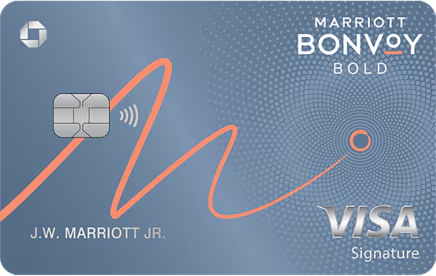
| Bonvoy Bold | Chase | $0 | 3x | None |
| Bonvoy Boundless | Chase | $95 | 6x | 35,000 pts |
| Bonvoy Bevy | Amex | $250 | 6x | 50,000 pts |
| Bonvoy Bountiful | Chase | $250 | 6x | 50,000 pts |
| Bonvoy Brilliant | Amex | $650 | 6x | 85,000 pts |
The Chase side runs three tiers already covered in depth in the Bonvoy Bold vs. Boundless vs. Bountiful comparison, including welcome bonus and Elite Night Credit details for each. The Amex side adds two cards not covered there. The Bonvoy Bevy sits at $250 a year with a $300 annual Marriott Eat & Drink credit and 15 Elite Night Credits. The Bonvoy Brilliant is the top-tier option at $650 a year, pairing a larger 85,000-point free night certificate with Priority Pass Select lounge access, a Global Entry or TSA PreCheck credit, and $300 in annual dining credits split across smaller monthly increments.
Only one flexible currency transfers into Bonvoy. American Express Membership Rewards moves 1:1, making it the practical path to a Marriott balance for anyone not carrying a Marriott co-brand directly.
If you're deciding between the two fee-based Chase tiers specifically, the Boundless vs. Bountiful comparison breaks down the fee gap against the larger certificate, elite status, and statement credit on the Bountiful.
Should You Hold a Marriott Co-Brand?
The decision comes down to how often Marriott's roughly 9,000 properties intersect with where you actually travel. A traveler who books Marriott two or three times a year clears the fee on the mid-tier cards through the free night certificate alone, especially when it is used at a property priced near the cap. Someone who rarely stays at Marriott properties is better served earning Membership Rewards or Ultimate Rewards on a flexible card and transferring into Bonvoy only when a specific stay calls for it.
The Card Advisor can rank the five Marriott cards against flexible-currency alternatives based on your actual spending and travel pattern. For anyone holding one of these cards already, the Supapoints Benefit Tracker keeps the annual free night certificate, dining credits, and Global Entry reimbursement from expiring unused.
Bottom Line
Marriott Bonvoy points are worth roughly 0.7 cents each, trailing Hyatt and Wyndham on a pure per-point basis. The gap closes fast for anyone using a free night certificate at a property priced near its cap or booking five consecutive award nights to capture the automatic fifth-night discount. Treat the 0.7-cent figure as a floor rather than a ceiling, and Marriott's unmatched property count does the rest of the work.