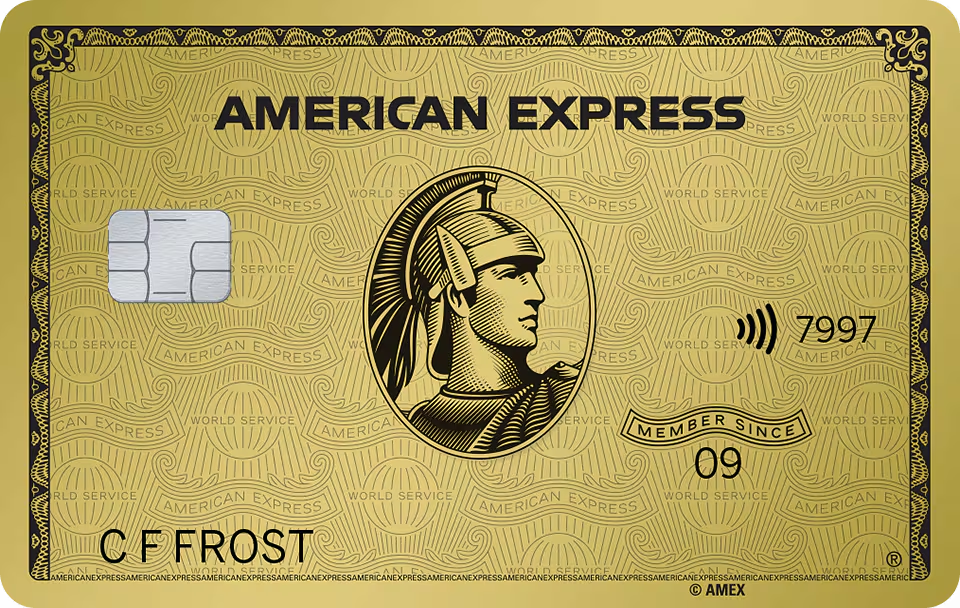
The Amex Gold charges $250 per year and offers over $340 in annual credits before you earn a single point. That means the card pays you to carry it at full utilization, which puts it in a category of one among mid-tier rewards cards.
Here's every benefit, how to actually use each one, and what the card costs after you do.
The $120 Annual Dining Credit
$10 per month at participating restaurants and food delivery services. The current lineup includes Grubhub, The Cheesecake Factory, Goldbelly, Wine.com, and Milk Bar. You must enroll in each merchant through your Amex account before the credit applies.
The credit is monthly and use-it-or-lose-it. No rollover between months. The $10 must be spent in a single transaction at one participating merchant. Splitting a $20 dinner into two $10 charges at a participating restaurant does not generate two credits. One transaction, one credit, one month.
The merchant list rotates periodically. Amex has added and removed partners in the past, so check your account for the current roster. At $120 per year, this single credit covers almost half the annual fee. A single Grubhub order or Cheesecake Factory lunch each month is all it takes.
The $120 Uber Cash Credit
$10 per month in Uber Cash, loaded automatically to your linked Uber account. Works for both rides and Uber Eats orders. No enrollment required beyond linking the card to your Uber profile.
No rollover between months. If you do not use the $10 in a given month, it disappears. The credit is identical to the Amex Platinum's monthly Uber Cash amount, but without the Platinum's December bonus (the Platinum gets $15 in December; the Gold stays at $10).
For anyone who uses Uber or Uber Eats even once a month, this is effortless value. One ride or one delivery order covers it. At $120 per year, this is the easiest credit on the card to capture consistently.
The $100 Hotel Credit
A one-time annual credit for hotel bookings of $100 or more through Amex Travel. Resets on your cardmember anniversary, not January 1. The credit applies to any hotel available in the Amex Travel portal. There are no brand restrictions, no minimum star rating, and no Fine Hotels + Resorts requirement like the Platinum's hotel program.
One domestic hotel night easily clears the $100 threshold. A single night at a standard hotel in most U.S. cities costs $120 or more, so the credit applies in full with no partial-use concerns. The only constraint is that you must book through Amex Travel. Hotels booked directly with Marriott, Hilton, or other chains do not qualify.
For anyone who takes at least one trip per year, this is a straightforward $100 back. Combined with the dining and Uber credits, it brings total annual credits to $340 against a $250 fee.
Earning Rates: 4x Dining and Groceries
The Gold's headline earning rates are what set it apart from every other card in its price range.
| Category | Rate | Notes |
|---|---|---|
| Restaurants worldwide | 4x | No cap, includes delivery and takeout |
| U.S. supermarkets | 4x | Up to $25,000/year, then 1x |
| Flights | 3x | Booked directly with airlines or through Amex Travel |
| Everything else | 1x | All other purchases |
At Supapoints' valuation, 4x Membership Rewards points are worth approximately 6-8% back depending on redemption method. That makes the Gold one of the highest-returning cards for dining and grocery spending at any price point.
The grocery cap is generous. $25,000 per year covers over $2,000 per month in supermarket spending, which is well above the average U.S. household's grocery budget. The key distinction: warehouse clubs (Costco, Sam's Club) and supercenters (Walmart, Target) are not classified as supermarkets by Amex and earn 1x. If your grocery spending is split between Kroger and Costco, only the Kroger purchases earn 4x.
Compared to the CSP, the Gold earns 4x on dining versus the CSP's 3x, and 4x on all U.S. supermarkets versus the CSP's 3x on online groceries only. For anyone whose food spending is a primary category, the Gold wins decisively on earning rates.
3x on Flights
3x Membership Rewards points on flights booked directly with airlines or through Amex Travel. This is a strong base rate for travel. Among mid-tier cards, only the Capital One Venture X (10x through the Capital One Travel portal) and the Amex Platinum (5x through Amex Travel) consistently beat it.
The direct-booking flexibility is the real advantage. You earn 3x whether you book through Delta.com, United.com, Southwest.com, or any airline website. No portal requirement. That means you can book directly with the airline, retain full control over your reservation, and still earn 3x.
For travelers who prefer booking through airline sites for status credits, schedule flexibility, or customer service access, the Gold's 3x structure is more practical than portal-only earning rates.
Transfer Partners
Membership Rewards points transfer 1:1 to 20+ airline and hotel partners. This is where the Gold's earning rates convert into outsized value.
| Partner | Program | Transfer Ratio |
|---|---|---|
| Delta | SkyMiles | 1:1 |
| ANA | Mileage Club | 1:1 |
| Singapore | KrisFlyer | 1:1 |
| British Airways | Avios | 1:1 |
| Air France/KLM | Flying Blue | 1:1 |
| Virgin Atlantic | Flying Club | 1:1 |
| Hilton | Honors | 1:2 |
Transfer partners are shared across all Membership Rewards cards. If you also hold the Platinum or Green, points pool into one balance. The most valuable redemptions are premium cabin award flights, where points regularly yield 2 cents or more per point. ANA first class to Japan, Singapore Suites, and British Airways short-haul awards are the consistently cited high-value targets.
For hotel transfers, Hilton Honors points transfer at 1:2 (1 MR = 2 Hilton points), which can work for aspirational stays but is generally lower value than airline transfers.
The Real Annual Fee Math
This is where the Gold makes its case.
| Credit | Annual Value |
|---|---|
| Dining credit | $120 |
| Uber Cash | $120 |
| Hotel credit | $100 |
| Total credits | $340 |
| Annual fee | $250 |
| Net cost | -$90 |
The Amex Gold pays you $90 at full credit utilization, before counting any rewards earned. Even at 70% credit utilization ($238 in credits used), you are still net negative on the fee. Add 4x on $500 per month of combined dining and grocery spending and the value equation is not close.
The Gold is not the cheapest card in its class. The Chase Sapphire Preferred costs $95 and still offers meaningful credits and transfer partners. But on raw credit value and earning rates in food spending categories, the Gold is the strongest mid-tier card available.
Bottom Line
The Amex Gold pays you $90 per year at full credit utilization before earning a single point. Add 4x on dining and groceries and it becomes the highest-value mid-tier card for anyone whose food spending is a primary category. If you spend $500+ per month on restaurants and supermarkets and can use the Uber and dining credits consistently, the math is not close. Run your actual spending through the Card Advisor to see how the Gold compares to every other card in our database.